

Stop Trying To Fight AI
Essay: The Trojan Horse is Already Here

On Sunday, the CEO of Microsoft Satya Nadella posted an essay on X that basically accused the entire AI industry of stealing data from enterprises like Microsoft with the intention of eventually replacing them.
The Reverse Information Paradox he described is as follows:
In the pre-AI world, when someone sells you information they bear the most risk because in order to convince a buyer to buy it… you need to show them the information first. The buyer could just walk away without paying you.
In the new AI world that’s completely flipped. Not only are we paying a hefty subscription fee to access these models - we’re also unloading our entire love-life, personal medical records and proprietary employer data (don’t deny it ;) ) into them.
According to Satya, this is a one-way ticket to handing over your business to Dario and Sam. Once they have your precious data, they can just train a better model to replace what your business does (or at least make you dependent on it).
His solution? Build walls around your business. Make it incredibly annoying for AI models to access your data.
I’m sorry, but I disagree and think anyone who does this will dig their own grave.
This article got 11 million views, and I noticed a LOT of cope. The truth is hiding from AI will actually leave you vulnerable to a smaller savvy startup.
Let me explain.
-Ejaaz
The Trojan Horse is Already Here
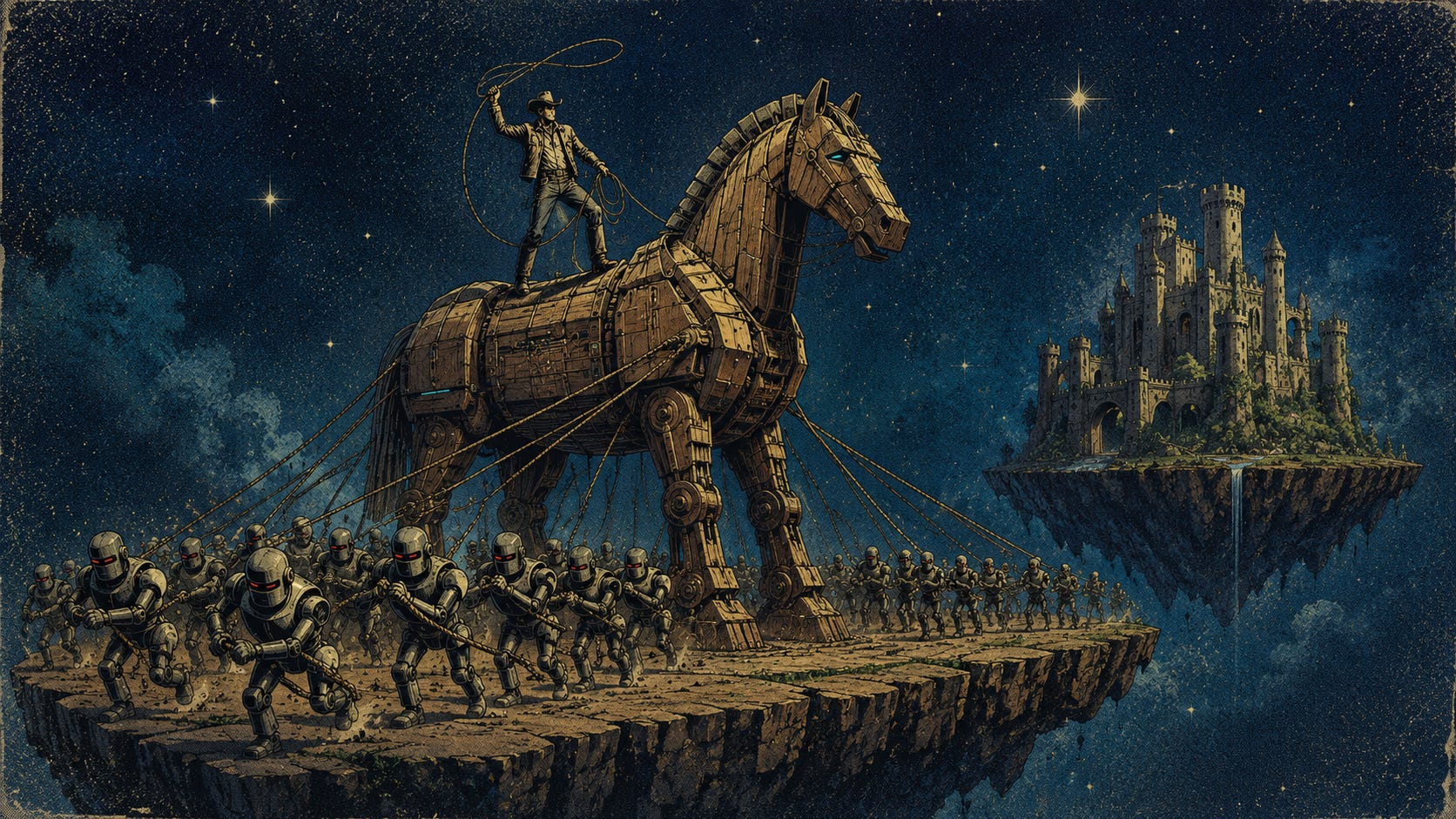
Any cinephiles in the room? I’m going to see Christopher Nolan’s The Odyssey this week, and there’s this epic scene where soldiers attack the city of Troy by hiding in a giant wooden horse disguised as a mysterious gift. The horse gets brought into the city, across their defensive walls, and while everyone’s asleep the Trojans sneak out and take over….
…anyway yeah you see where I’m going with this: Anthropic and OpenAI are the Trojans, and I don’t know about you… but Fable 5 and GPT 5.6 are looking like incredible wooden horses.
Every prompt your employees write, every tool their agents call, and especially every correction they make when the model gets it wrong will be logged, recorded, and sent back to the labs to train a better model.
But here’s the thing: that’s how you effectively use AI models in our business. It needs the context behind what you’re doing in order to help you do the job more effectively and uncover your blind spots. Putting up a wall around it will just ensure your business eventually dies.
Anthropic and OpenAI aren’t really selling software anymore. They’re wiring their models straight into databases that took companies like Microsoft and Salesforce decades of customer trust to build.
So I get it, I can see why Microsoft is sounding the alarm bells around building walls… but it’s not going to work.

Competitors Will Undercut you
Satya’s solution is five-pronged: own your data, build private learning environments, never depend on a single model, keep your infrastructure flexible, and keep the learning loop inside your walls.
All of these are fair suggestions, and tbh I agree with some of them.
But it only works if everyone holds the line, and I’ll bet all my Anthropic SPV equity that someone will cave and let the Claude Trojan in (like they’re already doing). What will they get in return? Much, much faster product development, a leaner team to save on costs and… oh yeah a much better product that’ll earn more money for the company.
The first competitor willing to plug in fully, share everything, and let the lab tune the model on its guts basically gets a materially better product. It ships faster, serves customers cheaper, and compounds while Microsoft is busy building walls.
I think the best defense against this is his suggestion to use multiple models and try to host as much of the reasoning and intents data locally on your business premises. Listen, locally hosted AI models are nowhere near where they need to be in terms of performance, cost, and function… but we’re making steady progress towards this being the case (shoutout Amazon).
Hypocritical from Microsoft
Microsoft poured billions into OpenAI, and their stake is currently worth $135 BILLION… so if anything Satya enabled this. Also their flagship product does exactly what he claims the frontier labs are doing. Copilot is designed to reach into your email, your files, and your chats (in a 2024 survey, roughly half of data chiefs had paused or restricted it over this exact fear).
Now in fairness his proposed fix, a neutral trust boundary at the cloud layer where your data stays yours exists, is called Azure.
BUT Microsoft is the worst-performing Magnificent 7 stock this year, down more than 18% so like… the user experience is obviously terrible, and Copilot fumbled the lead they had.
So What?
Tbh I don’t have the answer and I can empathize heavily with what Satya’s saying… I just don’t think the answer to Man discovering the closest thing to magic is closing yourself off from it.
I think they should (cautiously) optimistically open their arms to AI models, be the quickest to figure out how to leverage the models to grow the business, and be the first to create the new primitives to sit on top of this new weird world where AI models automate a LOT of today’s valuable work.
Godspeed baby.
Thanks for joining us for our latest issue. Now go listen to our podcast :)
i love that you explained what a Trojan horse is. ;]
I don’t think the claim you’re rebutting is the one Satya made. He never says the lab trains a model to replace what your business does. His claim is that economic value converges toward whoever owns the learning infrastructure. That’s about where the rent lands, not whether you survive.
Your adoption-pressure point is right, but it is aimed at a thesis he didn’t advance. Firms won’t sit out if integration makes the product better, and Satya would grant that immediately. His question is who keeps the compounding once everyone has plugged in.