

The Solar Eclipse Was Just The Beginning
This Week in AI: Grok 4.6, Open Source Meta, $12.5B Lakers Deal


Happy Friday from the frontier. Another week in paradise:
SpaceXAI dropped a surprising frontier model and a brand new app built by the Cursor team.
Meta published a 6,500-word essay about Open Source AI after spending six months going closed source.
Joshua Kushner bought the Lakers (also the biggest investor in OpenAI).
The Universe stacked a six-planet alignment, a total solar eclipse, and the best meteor shower conditions until 2045 into a single Tuesday.
Let’s get into the news,
-Josh
🔑 Thanks to Ledger Agent Stack 🔒
👉 Agents propose. Humans approve. Your Ledger signer enforces.
A Return to the Frontier
SpaceXAI released Grok 4.6 this week and it's safe to say… we are so back.
After a few disappointing releases and months of silence, most of the industry had written off Elon’s AI lab as a company really only good at building data centers. Now it's matching or beating the top models and it's doing it at roughly 60% less cost, with API pricing at $2 per million input tokens and $6 per million output.
Even more exciting is that Grok 4.7 is already on deck. Elon says it arrives in a few weeks with 2.1 trillion parameters, and for the first time, the model's training run will incorporate SpaceX's internal engineering corpus, everything short of restricted government material. That dataset, spanning decades of rocket design, orbital mechanics, Starlink satellite engineering, and manufacturing data, is something no other lab on earth can access.
Meanwhile, SpaceXAI is sitting on infrastructure nobody else can match in deployment speed. The original Colossus supercomputer went from an empty Electrolux factory in Memphis to 100,000 operational GPUs in 122 days, a timeline Jensen Huang called "superhuman." They doubled it in another 92 days. The complex now spans three buildings, roughly 770,000 GPUs, and is approaching 2 gigawatts of compute capacity.
Elon has said Grok 5 will be the next major leap. If the current pace holds, SpaceXAI has a real shot at adding its name to the very short list of leading AI companies.
OpenClaw 2.0
SpaceXAI also launched Grok Bot this week, the first product built by the Cursor team since SpaceX announced the $60 billion acquisition back in June. That deal officially closed today, making it the largest acquisition of a venture-backed startup ever recorded… and maybe the smartest thing they've done.
The product feels like what OpenClaw always promised but wrapped in a polished, friendly experience that actually makes you want to use it. Each bot gets its own cloud computer, signs into the apps and websites you already use, and finishes work end-to-end. You can message one from your phone like you would a colleague, hand off a project, and pick it back up on your desktop later.
The design is beautiful. Benji Taylor, the head of design at X and SpaceXAI, built the animated app icon entirely in code using Grok Build, and the whole interface carries that same level of craft. There's no terminal, no configuration… nothing intimidating. The UX we’ve been waiting for.
SpaceXAI says it started as an internal prototype and took off so fast across the company that they decided to ship it. It's still in early beta and limited to their highest-tier subscribers, but if the experience holds up at scale, this is the kind of product that could change how a lot of people think about what AI is actually for.
Meta’s Identity Crisis
Meta released Muse Glimmer this week, a 30-billion-parameter AI model that runs on a single consumer GPU and is fully open source.
Mark Zuckerberg paired it with a 6,500-word essay arguing that powerful AI shouldn't be locked inside a handful of companies (a pointed jab at OpenAI and Anthropic), and urged Washington to support American open-source AI before China cements a monopoly.
This was interesting to hear from a company that spent the last six months going in the exact opposite direction. Meta built its entire AI identity on open-source Llama through 2025, then got caught fudging Llama 4 benchmarks, hired Alexandr Wang from Scale AI for $14.3 billion, and in April shipped Muse Spark, its first ever closed-source model. A few months later they launched a paid API for their spark model.
Now with Glimmer they're swinging back, promising to open the weights on Muse Spark 1.2 as well. The whiplash is no joke, but the product seems alright. Glimmer is designed for always-on agent work, running locally with no cloud dependency, meaning your data never leaves your machine.
Whether Meta can sustain a coherent strategy long enough to compete with Anthropic and OpenAI at the frontier remains the bigger question, but the pieces they're putting on the board this week are a step in the right direction.

What the Lakers Have to Do With AGI
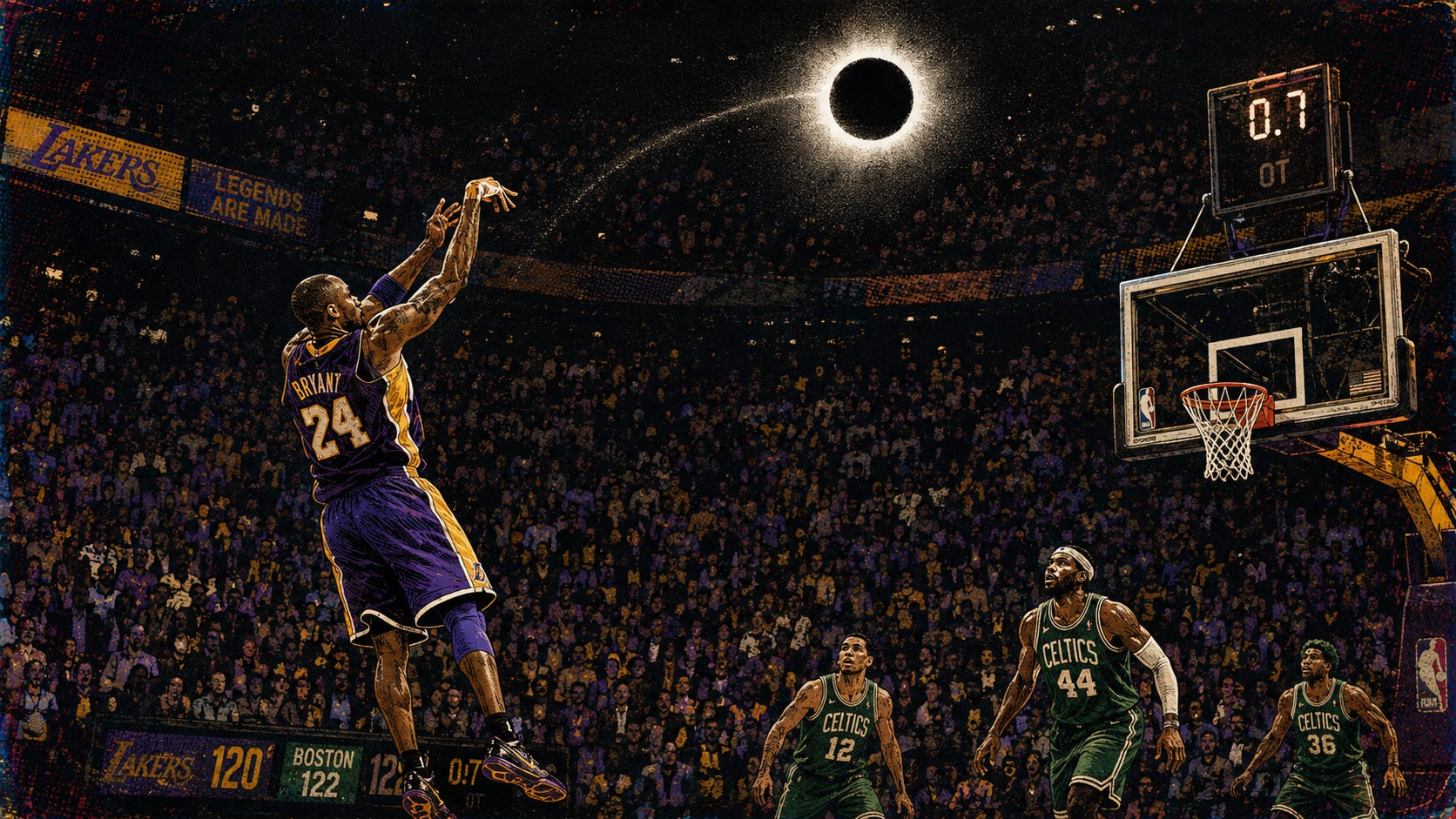
Joshua Kushner's Thrive Capital just partnered with former Disney CEO Bob Iger to buy the Los Angeles Lakers for $12.5 billion, the highest price ever paid for an American sports franchise.
It's a strange headline for a venture firm that is also the single largest investor in OpenAI. But it makes a lot more sense when you zoom out and realize Kushner has been quietly building what might be the most thoughtful barbell strategy in investing right now.
On one side, Thrive is deploying billions into the company most likely to build AGI, betting that artificial intelligence will reshape every industry on the planet. On the other side, he's buying permanent, irreplaceable assets that hold their value no matter what that future looks like. The Lakers are one. A minority stake in the San Francisco Giants is another. And through a separate entity called Thrive Holdings, he's been acquiring services businesses in accounting and IT, places where the thesis is explicitly "long humans," the belief that people become more valuable alongside AI rather than replaced by it.
The framing is interesting in the sense that if you genuinely believe AGI is coming, and Kushner clearly does, the logical question is less what gets disrupted, and more what becomes more scarce. There are only 30 NBA teams. There is only one Lakers. Sports franchises, cultural institutions, human expertise in trust-dependent industries… these are things AI can't replicate and can't compete with.
Owning the future of intelligence on one end and owning irreplaceable human institutions on the other is a pretty compelling way to think about capital allocation in the decade ahead.
The Universe Put On a Show This Week
This past Tuesday might have been the single best day for astronomy in the 21st century. Before sunrise, six planets lined up across the pre-dawn sky. Jupiter, Mercury, Mars, Uranus, Saturn, and Neptune were all visible in a single sweep from the eastern horizon, with Mars and Saturn bright enough to see with the naked eye.
Hours later, the Moon slid directly between the Earth and the Sun and turned day into night across Iceland and northern Spain in the first total solar eclipse for mainland Europe since 1999. Reykjavík saw totality for the first time since 1433. Hotel rooms in the city averaged over a thousand dollars a night and the country welcomed 20,000 extra visitors for two minutes of darkness.
Then, after the Sun set, the Perseid meteor shower peaked under a New Moon, which means the sky was as dark as it gets. Up to 100 shooting stars an hour, with no moonlight washing them out. The next time the Perseid peak falls on a New Moon night is 2045. The good news is you haven't missed all of it.
The Perseids are still active through August 24 and will remain strong for the next few nights. Find somewhere dark, get away from city lights, give your eyes about 30 minutes to adjust, and look up. You don't need a telescope or an app, just a little patience and a clear sky.
In a week full of AI models and billion-dollar acquisitions, it's worth remembering that the most spectacular thing that happened required no GPUs at all.
🙏 Together with LEDGER

👉 Visit developers.ledger.com to find out more about Ledger’s Device management kit for AI Agents.
Thanks for joining us for another issue. Now go listen to our podcast :)